On September 29, President Donald Trump and leaders from six of America’s foremost artificial-intelligence companies signed the White House Accord on Super Intelligence. Google, Anthropic, Meta, OpenAI, xAI and Nvidia agreed to a common framework for developing increasingly capable systems responsibly.
The accord represents an important milestone. Competing companies have formally accepted a shared structure for internal controls, independent evaluation and board accountability. The administration deserves credit for bringing these industry leaders together and turning years of safety debate into an initial operating framework.
The agreement also responds directly to concerns raised by former Anthropic researcher Jacob Coxon when he resigned in September. Coxon warned that competitive pressure could push frontier laboratories to develop systems whose capabilities they could not adequately understand or control. He highlighted potential cyber, biological and other dangers and argued that companies could not safely police themselves while racing one another.
The accord establishes a practical starting point for addressing them while allowing the United States to continue leading global AI development. Its results can inform future legislation by showing which controls work, how they should be measured and where voluntary commitments require enforceable support.
The framework has four principal layers.
- First, each company will maintain robust internal controls for monitoring capabilities and alignment during training and deployment, including cyber, biological and chemical risks.
- Second, an empowered internal team will verify that those controls work and require remediation when weaknesses are discovered.
- Third, independent external auditors and evaluators will test the controls, so companies are not simply grading their own work.
- Fourth, an independent board committee will receive those findings and oversee remediation, making AI safety a formal corporate-governance responsibility.
This framework can also create an entirely new audit and assurance industry. Firms such as PwC, Ernst & Young, Accenture, IBM and Deloitte now have a market incentive to develop AI-control testing, continuous monitoring, risk mapping and evidence-management practices. This establishes an infrastructure for superintelligence” based on end-to-end traceability, mapping corporate policies to identified risks and preserving evidence for boards, customers, regulators, insurers and courts.The economic stakes are extraordinary. Industry leaders estimated that one gigawatt of productive AI infrastructure would support between $40 billion to $60 billion in annual economic output. This industry estimate illustrates why datacenter and energy infrastructure have become national priorities. Federal policy now explicitly supports faster construction of data centers, transmission and dedicated generation as infrastructure essential to national security, economic competitiveness and scientific leadership.
Maine’s goals align with that national mission. We need private investment, stronger communities, skilled careers, new energy infrastructure and productive reuse of former industrial sites. Maine offers a cold climate, available land, renewable-energy potential and communities with a proud history of supporting major industry.
Responsible Development in Maine
Maine Vision 2040 proposes a responsible-development compact built around the same principles guiding the Maine Data Center Advisory Council: protect ratepayers, maintain grid reliability, minimize environmental impacts and enable appropriately sited economic development. Projects should disclose their expected power and water requirements, pay the costs they create, meet Maine’s environmental standards and enter enforceable community agreements covering jobs, workforce training, infrastructure and long-term local benefits.
The White House has established a compatible national standard. Under its Ratepayer Protection Pledge, large data-center operators are expected to build, bring or buy the generation needed for their facilities, pay for required transmission and distribution upgrades, accept rate structures that protect other customers, invest in local workers and contribute to grid resilience. The Super Intelligence safety accord adds another layer: internal controls, independent evaluation and board-level accountability for the systems operating inside these facilities.
These safeguards support the national mission rather than slowing it. The competition with China will not be won through better algorithms alone. America also needs advanced chips, secure computing facilities, abundant electricity, transmission capacity, skilled workers and communities prepared to host strategic infrastructure. Maine can contribute to that national capacity while demonstrating that speed, public protection and local economic development can advance together.
That requires an attitude focused on how Maine can accomplish responsible development. We should identify existing and underused power capacity, particularly around former industrial sites, and use it to begin demonstration projects or modular first phases wherever utilities confirm that service will not compromise reliability or raise costs for other customers. At the same time, developers should be required to finance new generation, substations, transmission, storage and other infrastructure needed for expansion. This bridge from available power to new power would allow Maine to get started now while building the larger energy platform required for long-term growth.
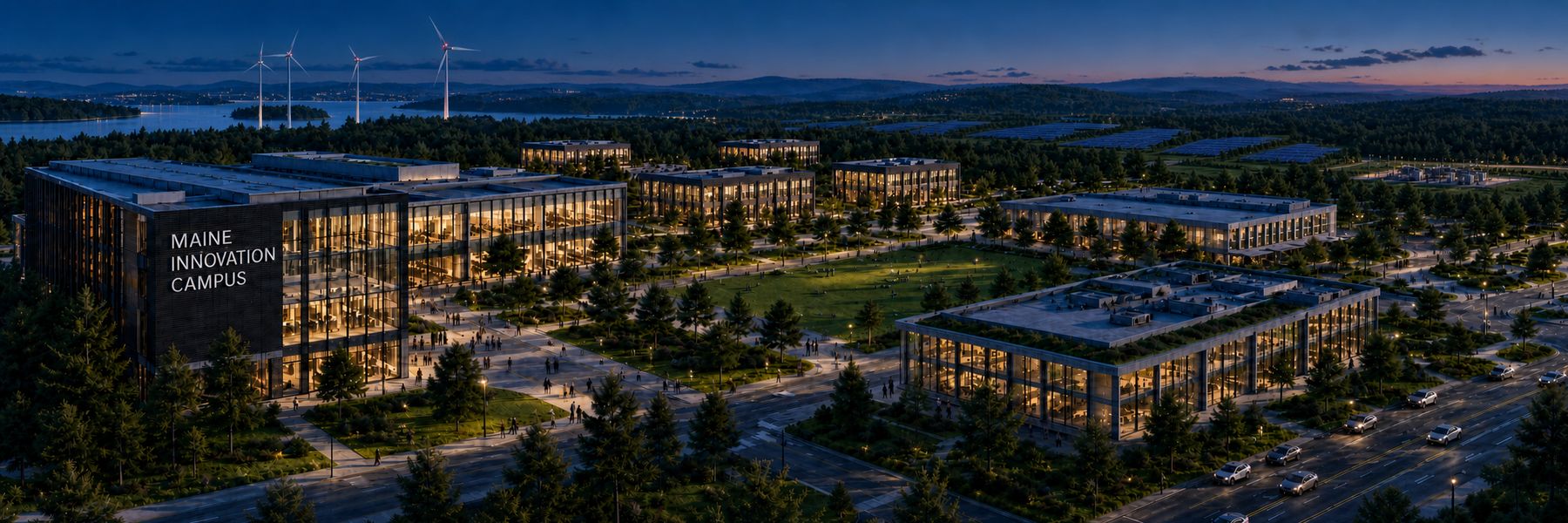
The Maine Vision 2040 model illustrates what this could mean locally. A 20-megawatt demonstration project in one town could represent approximately $1.08 billion of investment, peak at 505 construction jobs, support 67 permanent Innovation Center employees and approximately 80 additional regional jobs, create 200 homes and generate an estimated $117 million in municipal receipts over ten years.
At a larger scale, each operating 250-megawatt phase of a Maine Innovation Campus is modeled to provide its host community with $10 million in its first operating year, $15 million in its second and $20 million annually beginning in its third year. These are planning assumptions that would require negotiated agreements and independent validation.
When the state scales out to a full 1 GW in AI capacity with either one large innovation center or smaller distributed AI factories the economic impact is compounded. Maine Vision 2040 model’s estimated:
- $4.7B in construction payroll over 10 years, 6,000 workers at peak with an estimated 34,000 worker years
- 1,000 direct campus jobs, and an additional 3,000 regional jobs for a total annual payroll of $500M
- $100M + in additional town revenue per year for those communities that choose to participate
- Total estimated economic impact to the state between $93B to $138B over 10 years
- GDP growth of 3.6%
While these benefits are significant, they are based on a $6B per year in revenue. We expect revenue to be much higher exceeding $20B per years which will only amplify the benefits for Mainers. Responsible AI development can protect the public and expand opportunity at the same time. With strong safety controls, independent audits and enforceable community benefits, Maine can create jobs, strengthen local economies, use its natural advantages and help America maintain its leadership in the defining technology of our generation.
This essay is one founder's view. The questions Mainers raised about data centers, and where Maine Vision 2040 stands on each, are answered in Straight Answers, with every model figure labeled as the planning estimate it is. If you read this and disagree, we want to hear it.